
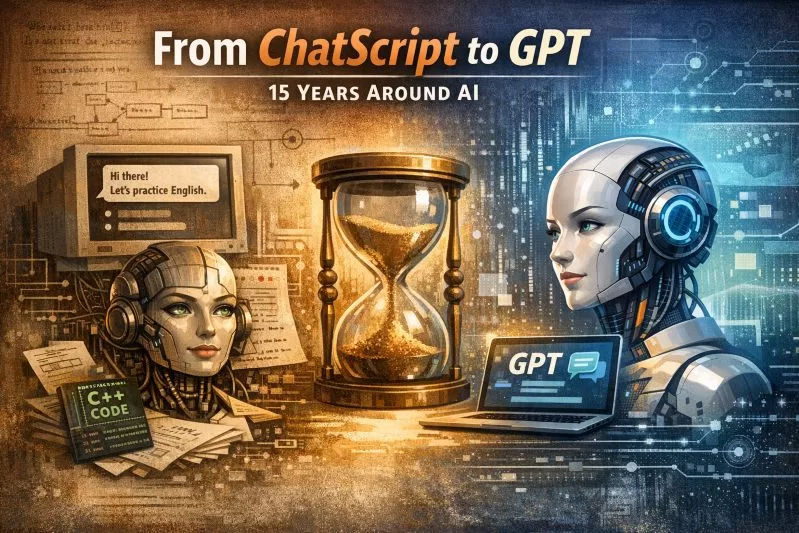
In 2011, I worked on a chatbot project for a Japanese startup called SpeakGlobal.
At the time, AI wasn’t a buzzword.
No large language models. No hype. No cloud-scale intelligence.
Just one simple question: Could software help people practice spoken English without a human tutor?
Today this sounds obvious. Fifteen years ago, it felt futuristic.
When chatbots were built by hand
Early chatbots didn’t really think — they reacted.
They were based on rules, patterns, and carefully scripted dialogs. One of the most advanced systems of that era was ChatScript, created by Bruce Wilcox, a multiple-time winner of the Loebner Prize.
During the SpeakGlobal project, I worked directly with Bruce on integrating his chatbot Suzette into our platform.
Suzette’s engine was written in C++, roughly 25,000 lines of code — a serious, handcrafted system built long before modern AI frameworks existed.
Back then, intelligence wasn’t trained. It was engineered.
The SpeakGlobal idea
SpeakGlobal, founded by Tosh Iguchi, aimed to help people practice English through chatbots, simple games, and conversations with other learners.
The product worked. Demos were impressive.
But after longer use, the limits became clear.
The bots could talk — but they couldn’t teach.
They couldn’t explain mistakes, adapt to a learner’s level, or show clear progress. Without that feeling of improvement, users didn’t stay — and they didn’t pay.
Too early, not wrong
Looking back, the idea itself wasn’t the problem.
Timing was.
In 2011, we didn’t have large language models, cheap compute, or AI that could reason across longer context.
We were trying to manually build what today emerges naturally from scale.
What changed with GPT
Modern AI no longer follows scripts.
It generates conversation, keeps context, explains reasoning, and adapts to the person it talks to.
We stopped programming dialogs. We started training behavior.
That changed everything.
One delivery lesson
AI still isn’t human.
But it doesn’t need to be.
What matters is this: It became useful.
Not a replacement for people — but a thinking partner.
And after 15 years around AI, that’s the biggest shift I’ve seen.