
In software delivery, one of the most expensive mistakes a business can make is demanding a precise estimate for a massive project before a single line of code is written.
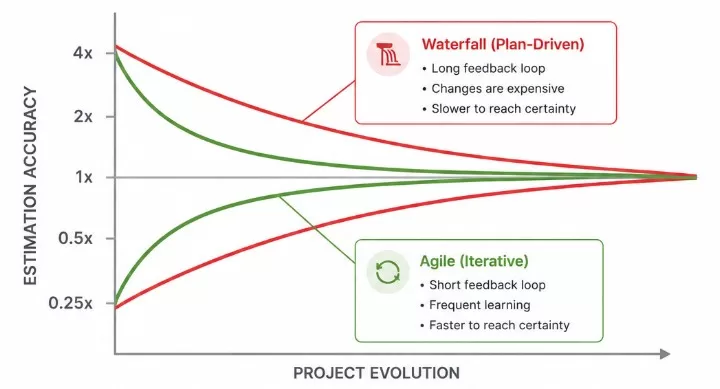
There is a well-known concept in project management formalized by Steve McConnell: The Cone of Uncertainty. It proves a simple mathematical reality – at the absolute beginning of a project (the “What are we building?” phase), the variance in estimation is staggering. Your timeline and budget can be off by a factor of 2x to 4x in either direction.
The image above illustrates this perfectly. Yet, traditional organizations still spend weeks trying to build exhaustive specification documents, hoping to cheat the statistics. They can’t.
The Waterfall Trap vs. The Agile Pivot
In a traditional Waterfall model, you attempt to push through the entire lifecycle – Requirements, Architecture, Design, and Development- as one continuous timeline. You are essentially carrying a massive Cloud of Uncertainty throughout the entire project. Because you are estimating things that won’t be touched for six months, your error margin compounds.
Agile and Scrum do not fight the Cone of Uncertainty; they artificially compress it.
Instead of estimating an entire year of development under a 4x uncertainty factor, we cut the scope into small, highly granular increments – Sprints.
Granularity Equalizes Estimation
The logic is straightforward: The more detailed our immediate understanding of a task, the closer the team’s estimation is to reality.
Here is how Scrum mathematically solves the estimation problem cycle after cycle:
- Micro-Focusing the Cone: We do not attempt to highly detail a 6-month backlog. We focus on refining only the top chunk of the product backlog for the upcoming 1–2 sprints.
- Deep-Dive Technical Alignment: During Backlog Refinement, the team looks at a highly specific, isolated scope. We answer the core architectural questions (“How does it work?” and “What will it look like?”) before the sprint planning.
- Drastic Error Reduction: Because the scope is narrow, the team operates at the narrowest point of the Cone of Uncertainty (the 1.1x to 1.25x range). The margin of error drops from a catastrophic 400% to a manageable 15–20%.
Delivery Predictability is About Cadence, Not Guesswork
As a Delivery Consultant, I frequently see companies struggling with predictability. They ask, “Why is the team always missing deadlines?” The answer is rarely about the team’s engineering velocity; it is about the scope’s lack of definition at the time of estimation.
By keeping the backlog lean and refining only what is immediate, you save dozens of hours of wasted estimation overhead on features that might change anyway. You gain high predictability where it matters—in execution speed and sprint-by-sprint delivery.
Stop asking teams to estimate the unknown. Focus on providing radical clarity for the next two weeks, and watch the estimation gap collapse naturally.
Need to optimize your engineering velocity and stabilize your delivery pipelines? Let’s connect for a Consulting Audit